
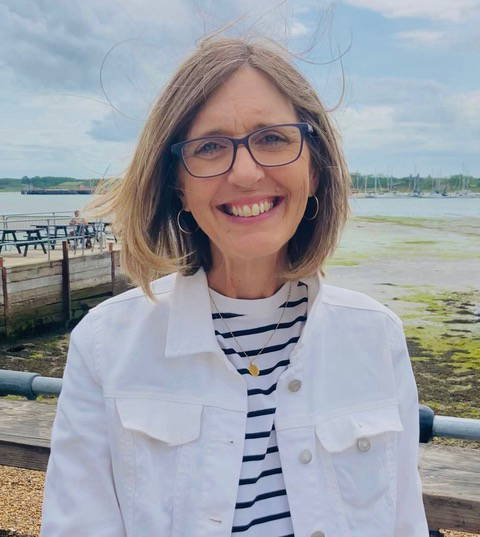
When was the last time you paused and asked yourself why you do what you do every day? For Gosport resident, Alison Allsopp, that question isn’t just philosophical – it’s her way of life.
Alison has lived in Gosport since the 1980s, moving to the area at the age of 23 when her husband took a job with the Ministry of Defence. Fresh from studying French and Spanish at London University, she admits she wasn’t quite sure what she wanted to do next.
“I’d spent time in Paris and Barcelona and loved languages, but finding work that used them at a higher level wasn’t easy,” she says. “So, I came to Gosport, started in PR and marketing, and found myself learning about communication in a completely new way.”
After roles with a Fareham PR agency and an international technology company in Portsmouth, Alison realised she wanted something more meaningful. “I loved the creative side of planning and presenting,” she says, “but I missed the human side of things.” That realisation led her to retrain as a primary school teacher.
In 1992, Alison completed a PGCE at the University of Southampton and began teaching in local schools, including Alverstoke, where she spent the majority of her career. “What I loved most was building relationships with children and helping them grow, and encouraging them to think, to question, to be curious. Teaching, for me, was never just about passing tests. It was about inspiring curiosity, creativity and aspiration.”
But as the education system became increasingly focused on targets and testing, Alison began to question the purpose of what she was doing. “We were covering so many facts and figures that didn’t always feel relevant to children’s lives,” she says. “I wanted them to think more deeply and develop communication skills that would help them grow into confident, thoughtful adults”
That’s when she discovered Philosophy for Children, which changed the whole focus of her career.
The art of thinking
“One training day during my teaching career, I came across the approach of Philosophy for Children, and as soon as I saw what philosophical enquiry could do, as in getting children to think for themselves, to question, to explore what matters in life, I was hooked and saw so much meaning and purpose in equipping children with life skills.”
Alison adopted philosophical thinking in her teachings and soon went on to train with the national charity SAPERE (now known as Thoughtful), becoming an independent trainer and mentor for teachers across the country.
“It was the answer I’d been looking for,” she says. “Thanks to this approach, the children I was teaching were learning to think critically, creatively and compassionately, to argue with good reason, to listen, and to care about other people’s views and opinions”
Alison went on to balance her teaching with national training projects, working in schools not just in Hampshire but nationally. She eventually left mainstream teaching in 2016 to focus entirely on her philosophical work. “Seeing schools take it up and commit to it was wonderful,” she says. “You could see the change in teachers and children, and not just in the classroom, but in how they thought about themselves and others.”
Bringing Philosophy to Gosport
After the pandemic, Alison decided to take her thinking closer to home. “I’d stepped back from the charity and wanted to keep my philosophical practice alive,” she explains. “It was my daughter who suggested a community group, and from that, my community group – ‘Philosophical Friends’ was born. We have been running for over two years and are a growing, friendly discussion group that meets monthly in YourSpace in Gosport for an hour and a half.
The group explores big ideas about life, and is guided by stories, images or questions that Alison brings to spark conversation.
“It’s not an academic class,” she says. “It’s a space to think, to listen, to question and to be heard. We might start with something simple, like a story or a theme such as ‘wants and needs’, and from that, people form their own questions. A topic we explored recently was, ‘Why do we want so much? Why are we so consumer-driven? What do we really need to live well?”
Alison says the community group attract a mix of people, from retirees to younger adults in their thirties who are looking for a safe space to talk and think together. “People often say they feel really listened to after attending a session” Alison says. “They enjoy hearing other perspectives and often either realise they’re not alone in what they’re feeling, or that they have learnt a new, wider perspective on a topic.”
Conversations that matter
Some of the group’s discussions have been surprisingly deep, Alison says. “One of the most memorable was when we asked, ‘What if we could live forever?’” Alison recalls. “People shared personal thoughts about life and death and meaning, and the conversation became one of hope. “We realised that life’s limits are what give it value.”
For Alison, these sessions are about more than conversation. They’re about connection. “When people pause to think, they start to see what really matters to them, their values, their purpose. That can help you find direction, build self-esteem, and face life’s challenges with more confidence.”
Alison believes philosophy helps people to understand themselves and others better. “When we listen actively and reflect before responding, we become more empathetic,” she says. “We might not always agree, but we can understand where others are coming from. That’s powerful – especially in a world that can feel so divided.”
Everyday Philosophy for a better life
To Alison, philosophy isn’t something distant or academic; it’s deeply practical. “It’s about pausing to reflect on what we really care about in life,” she says. “Thinking and questioning critically about what we hear and see, especially in a world full of information and opinion.”
Research supports Alison’s claim: national research show that philosophical enquiry positively affects seven of the top ten skills for life and learning, such as resilience, motivation, creativity, and critical thinking. “These aren’t ‘soft skills,’” Alison explains. “They’re essential skills for work, relationships and wellbeing.”
The power of thinking together
Alison’s belief in the power of philosophy has shaped not only her work but also her family life. With two grown-up daughters, both of whom have absorbed her love of questioning, and a husband who’s a scientist and “a philosophical thinker in his own right,” she says it’s a way of living that runs deep. “We’re always asking questions in our family – about what things mean to us, how we live, and what really matters. It’s part of who we are.”
Now, as she looks to the future, Alison hopes to expand her community work. “I’d like to keep advocating for practical philosophy in education and in everyday life,” she says. “To take these conversations wherever they’re needed – whether that’s in schools, in communities, in workplaces. People want meaning and connection. They need the space to explore it.”
And what does she hope people take away from her sessions? She smiles. “To pause. To think. To ask better questions. When we do that, we don’t just survive life — we really start to live it.”
Join Philosophical Friends
- Every second Wednesday of each month
- YourSpace, Gosport, 10.30am–12pm
- Find ‘Philosophical Friends Gosport’ on Facebook or Facebook message Alison direct if you have any questions.