
Locked in a cell for up to 22 hours a day at HMP Belmarsh, Duke Harrison-Hunt shared a concrete room with a man he had never met. In that bleak space, while watching his Muslim cellmate pray five times a day, he found light in one of the darkest places imaginable. “I didn’t understand praying to something unseen,” he says. “But I watched, learned, and asked questions. He taught me respect, routine, and the power of belief.”
That quiet transformation planted a seed. Duke began to ask himself: What do I carry? What do I believe in? What do I want others to understand about me?
At 62, Duke now walks through Paulsgrove with a calm pride. Since settling in Portsmouth in 2009, he has become a familiar and respected figure, which is far from the life that once confined him. Few people know the full journey behind the man who stands in school halls today, teaching young people about equality, resilience and respect.
His voice is gentle. His life was anything but.
Years later, those same questions continue to drive his work, not behind bars, but in communities like Gosport and wider Portsmouth, where he’s spent the last decade helping young people find their voices. Drawing from his own lived experience with addiction and adversity, he’s made it his mission to make sure that others are seen, heard, and valued.
“In the darkest of places, people carry light,” he says. And now, he’s helping others find theirs.
Gosport: building hope where it matters most
Duke spends time in Gosport, advising in schools and job centres, guiding young people and adults through employment support, behaviour work, anti-racism workshops and hope-building.
He attends local ambassador meetings, building community ties.
“Gosport’s a good town with great people and community spirit. I feel connected here.”
A childhood of fear and flight
Duke grew up in South London with his younger brother. Home was not a sanctuary, but a battleground. Domestic violence by their father dominated their early life.
“One day Mum just said she couldn’t take it anymore, so she left. I was nine and my brother was eight. This led to my father putting us into care.”
Duke says the children’s home offered them no refuge from abuse. With almost no children of colour there at the time, racism was constant and vicious. Duke and other black children formed protective groups, not gangs by choice, but out of necessity.
“You had to stick together to survive. Walking alone just wasn’t an option,” he says.
“The next blow – our father moved us to Jamaica to live with our grandmother, whom we didn’t know.”
At ten years old, Duke found himself living in a shack with no windows, no running water, and food grown in the yard.
“We cried every day. The shock of the lifestyle, the discipline, the poverty. It was intense.”
A year later, they returned to their father, where the cycle of violence continued.
“At 16, I ran. I couldn’t do it anymore.”
Years lost
For years, Duke drifted by sofa-surfing in London and stealing to survive. He didn’t have his own home again until age 27, and even then, stability was fragile.
A terrifying incident almost cost him his life when he was wrongly suspected of breaking into a neighbouring flat and was attacked, kidnapped, and beaten by three men.
“That night could’ve been the end of me.”
Addiction crept in. He didn’t recognise it at first. “I told myself, ‘I’m not that person. I’m not a junkie.’”
Duke went through rapid detox in London four times, but each time he was sent home after two weeks and quickly fell back into a routine of drinking and drugs. In his fourth year, he was offered complete rehab and given a one-way train ticket to Portsmouth.
“You live with other recovering addicts. I had a gym membership to promote a healthy mind and healthy body ethos, toiletries and support – but there was no handholding. You had to get out of bed and show up every day. You could hang yourself with the rope they gave you – or climb out.”
Duke deleted everyone’s numbers from his phone and, within months, completely rebuilt and rapidly changed his life.
“After six months of treatment and time in a dry house, I secured a council flat. I was 45, and by stopping the drink and drugs and changing my network, the real me came out. I realised I’d always been a good person – my addiction had just smothered it.”
Finding purpose through football and community
Duke first found his footing as an advisor with the Wheatsheaf Trust, supporting people into work and training opportunities. It was there that someone recommended connecting with Pompey in the Community, and something instantly resonated.
What began as coaching soon evolved into a deeper purpose, leading him into equality, diversity and inclusion work. From tackling racism in football and supporting disabled participants, to engaging fans, co-ordinating the wave flaggers on matchdays, and speaking in schools across Portsmouth and Gosport, his role became about far more than sport – it became a platform for change
Duke’s speaking engagements are intense, emotional, and brutally honest.
“I pour everything into them. When young people hear lived experience, they listen. Behaviour and belief systems shift.”
Awards, recognition, and finally being seen
Today, Duke’s name appears on the Premier League’s Wall of Honour as the first man of colour to have won the award for Portsmouth FC and Pompey in the Community. Duke’s name stands alongside inspiring figures celebrated on the Football Black List, including Marcus Rashford, Raheem Sterling, Bukayo Saka, Trent Alexander-Arnold, Nikita Parris and former professional Jobi McAnuff. He’s also the first man of colour in Hampshire to receive a handwritten letter from the Portsmouth FC owner in recognition of his achievement; an honour that carries deep personal meaning.
His achievements have been recognised through several honours, including the Hampshire FA Equality, Diversity & Inclusion Award, which celebrates his work in shifting attitudes within football, from delivering training to Portsmouth’s first team and staff, to ensuring that every new club employee completes equality education. Followed by the IMD International Men’s Day award, which he won for overcoming adversity.
Duke also received a Civic Award for his role in supporting the community during the COVID-19 pandemic, working alongside others to pack and deliver food parcels to vulnerable families when they needed it most.
Looking Forward
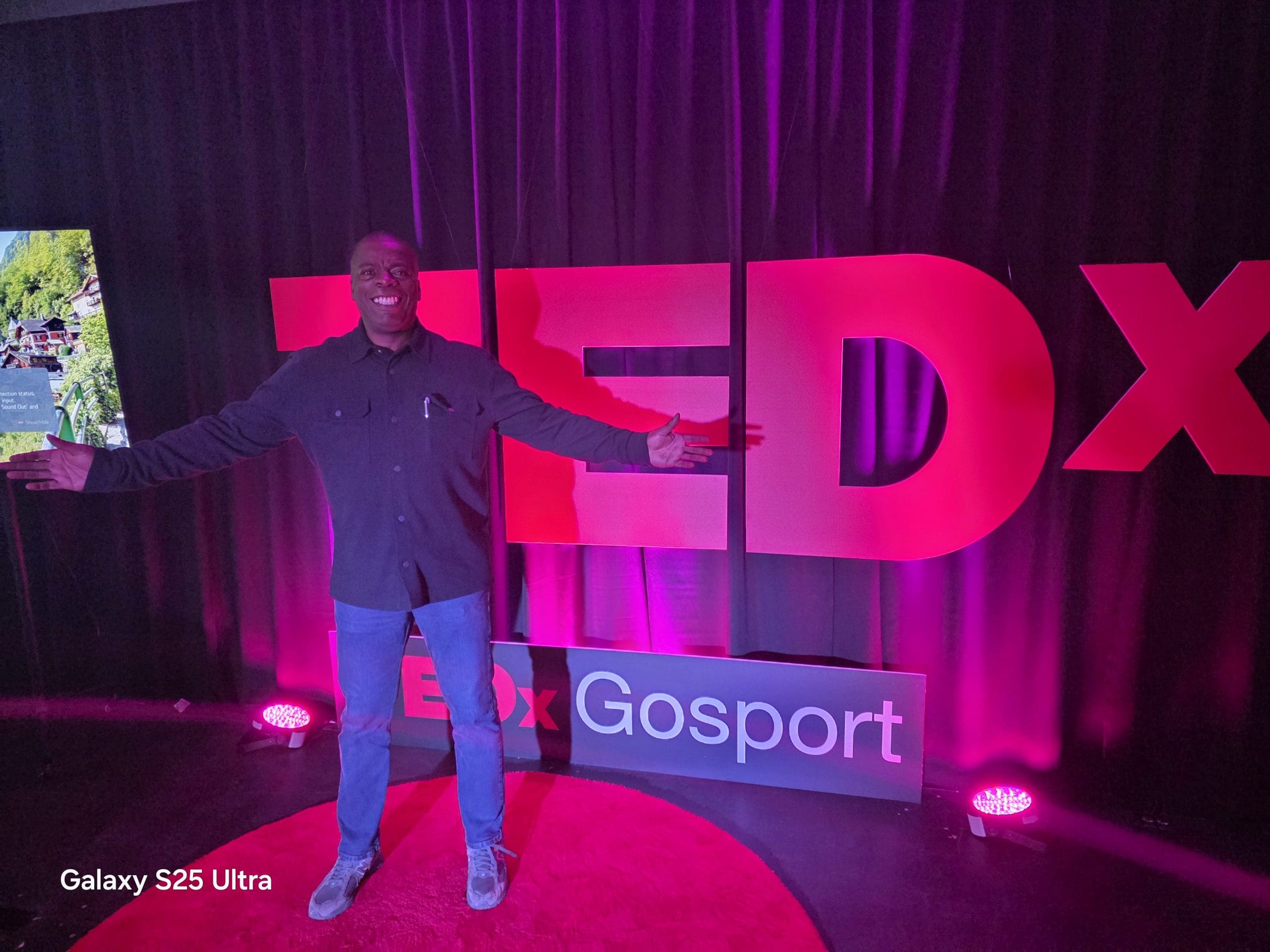
Duke gave a TEDx talk in October. Within seconds of the 17-minute talk, the audience was hooked. Duke’s life could have ended in violence, addiction, or despair. Instead, he rebuilt – not quietly, but brightly. He learned to stand up. He learned to give back. He learned to be seen. His journey is proof that the past doesn’t define you – what you do next does.
“I’ve always been this person. Addiction buried me for a while. Recovery brought me back. Now people see me, and I use my voice so others can see themselves, too.”
You can watch Duke’s TedX Talk here